 Dr. Antoun Toubia
The threat is real, but the popular image is wrong. This is a story about five cables, three systems, one narrow sea, and a region that has built an economy on the assumption that the data always flows.
24 October 2026 · Dr. Antoun Toubia
The threat is a plan, not a cut
On 21 October, Yadollah Javani, the political deputy of Iran’s Revolutionary Guards, warned that Iran could target seven major internet cables beneath the Strait of Hormuz if Iranian infrastructure came under attack. The next day, Mohsen Rezaei, secretary of Iran’s Supreme National Security Council, widened the list to oil facilities, data centers, artificial intelligence facilities and undersea cables across as many as seven Gulf countries. On 23 October, two senior Iranian security officials told Reuters that Tehran had detailed plans to cut cables and to prevent repairs.
Those statements are confirmed. An actual cable cut is not. The sources describe a threat that is conditional on a new American and Israeli attack, not an outage that has already begun. The distinction is not semantic. A plan can be a message, a bargaining chip or a warning. A cut cable is a physical event with a repair queue, an insurance claim and a political consequence.
The threat is best read as deterrence aimed at Washington and at Gulf capitals. Tehran wants the cost of another war to appear wider than the military targets inside Iran. That does not make the threat fake. It makes it a signal that has to be tested against physical evidence: ships moving toward cable routes, mines near Musandam, repair vessels leaving the Gulf, insurers withdrawing cover. None of those has been confirmed.
The political clock matters. The Guardian reported on 22 October that US military advisers had drawn up a target list for a possible new campaign after the US midterm elections on 3 November. That is a reporting line, not a schedule. It tells us why the next few weeks carry more risk than the last few months, not that an attack is certain.
What is actually under the water
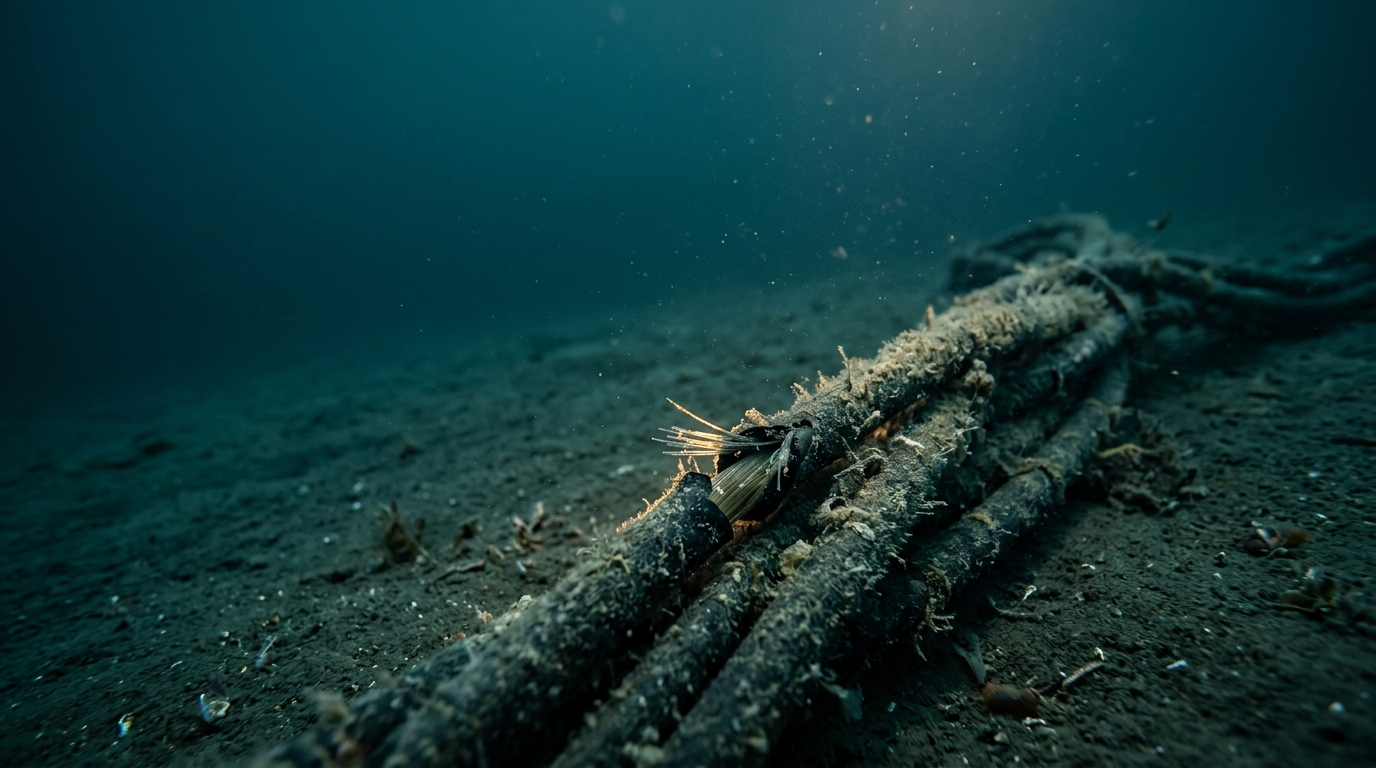
The International Cable Protection Committee counts five active submarine cable segments passing through the Strait of Hormuz. TeleGeography identifies three major systems serving the route: AAE, FALCON and GBI. The cables are routed through Omani waters for political and practical reasons, and they primarily serve the countries along the southern shore of the Gulf.
The number that circulates online is 25 cables. It is not the number in the cable data. Iranian officials speak of seven major cables. That is a threat estimate, not an independent inventory. The gap matters because a threat built on a larger number produces a scarier headline than the physical system supports.
The second number is even more important. The ICPC puts the share of the world’s international bandwidth that passes through Hormuz at less than one percent. The world’s internet is not a single pipe through a single strait. It is a mesh of submarine and terrestrial routes, and operators can move some traffic when one path fails. The Red Sea is the main artery between Europe and East Asia; it carries about 3 percent of global demand and around 10 percent of traffic between regions, according to TeleGeography.
That does not make the Gulf safe. It makes the impact regional first. A cut can slow connections, raise latency, interrupt cloud services, freeze payments and force companies onto thinner backup routes. It does not follow that the global internet goes dark.
History supports the distinction. In February 2024, three cables were damaged in the Red Sea, most likely by the anchor of the Rubymar, a cargo ship hit by Houthi missiles. TeleGeography says repairs took six months. In September 2025, four more Red Sea cables were damaged. In March 2024, four cables off West Africa were damaged and services were disrupted in 13 countries. In each case, operators rerouted traffic. The repair took far longer than the worst of the outage. A separate claim that repairs in Hormuz would take four to eight months is not confirmed by the sources I read; history says months, and wartime access can make it longer.
Why the Gulf is exposed first
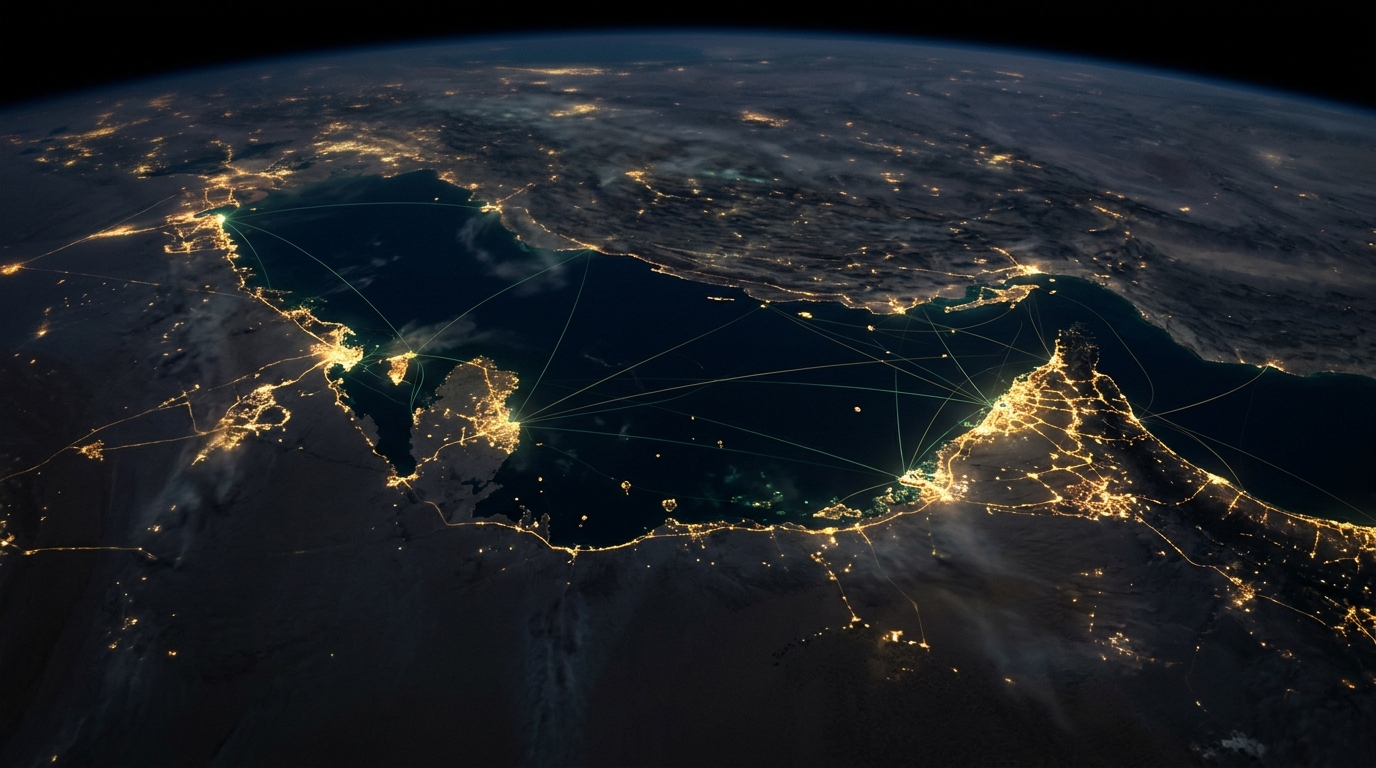
The cable landing points are concentrated. Bahrain, Qatar, Kuwait and the United Arab Emirates depend heavily on the routes that pass through Hormuz. Iran International, citing TeleGeography, reports that all four have alternative terrestrial connections, but the alternatives are thinner than the primary route. Saudi Arabia is less exposed because most of its international bandwidth lands on the Red Sea coast. Oman is the first landing point on the eastern side, which puts it at the center of any repair or rerouting plan. Iraq’s land route is an option, but it is congested and politically fragile.
In a severe scenario, the loss for some Gulf states could exceed 85 percent of capacity. That is a scenario estimate, not a measured fact. The point is not the exact number. The point is that the same event that is a bad week for global networks can be a systemic shock for a small, wealthy and data heavy economy.
The Gulf is also where the region’s AI buildout is concentrated. Data centers, cloud regions, banks, ports, airlines and government services all sit on the same coastal corridor. A cable cut is not only an internet problem. It is a payment problem, a logistics problem and a government continuity problem at the same time.
Three scenarios, one condition
I use three scenarios, all conditional on a new war. They are judgments, not model output.
A, gray attrition, 35 percent. Ships drag anchors or a small team sabotages three to six cables. Iran may deny involvement. The Gulf loses 30 to 40 percent of regional capacity and response times rise. This is the most plausible use of cables as pressure without a decisive escalation.
B, coordinated closure, 15 percent. Drones, mines and divers cut 15 or more cables. Some states lose more than 85 percent of capacity, and repairs are delayed by insurance, permits and security. This is the scenario that would turn a regional disruption into a prolonged crisis.
C, seabed and data centers, 5 percent. Cables in Hormuz and the Red Sea are hit alongside AI data centers. The Gulf suffers near total digital paralysis and the global economy absorbs a shock that is no longer only regional. This is the least likely and the most damaging.
No attack on the cables, 45 percent. Threats continue, or a war is fought without cutting cables. Markets may still reprice, but there is no connectivity shock. The four numbers sum to 100. If war resumes, I would move the weight toward A at about 50 percent, B at about 35 percent and C at about 15 percent. These are conditional estimates, not forecasts.
The timing question
There is no date. The highest risk begins in the first 72 hours after a new American or Israeli strike. That is when a plan would be executed, not announced. The practical window I would watch runs from now to mid November 2026. If talks collapse and the military buildup continues, the next window is December 2026 to February 2027.
The signals are physical, not rhetorical. Ships leaving berths. Mines near Musandam. Repair vessels leaving the Gulf. Insurers issuing force majeure notices. VLCC freight rates jumping. A Houthi escalation in the Red Sea. A strike on Iranian infrastructure. Two or three together justify raising readiness. They do not justify panic.
What markets price before the repair ships arrive
Markets do not wait for a cable to be cut. They price the probability. Oil and freight move first, because Hormuz is an energy chokepoint before it is a data chokepoint. Gold catches a safe haven bid. Equities fall, with technology and banks more exposed than energy producers. Crypto does not behave like a safe haven in the first hours; it trades like a high beta risk asset.
On 23 October, Brent closed at 111.81 dollars, gold at 4,009.7 dollars, the S&P 500 at 7,623.68, Nasdaq at 25,955.34 and Bitcoin at 81,269 dollars. Those are snapshots, not targets. The 10 year Treasury yield was 4.96 percent. The numbers tell us the market was already pricing geopolitical risk before the cable story reached a wider audience.
If I had to describe the market channel in one line: the first shock is energy, the second is confidence, the third is the cost of insurance. A cable cut adds a fourth: the cost of digital continuity.
What satellites can and cannot do
Satellite links are useful. They keep banks, embassies, ships, hospitals and emergency teams online when a fiber route fails. Starlink and other low earth orbit systems can move traffic quickly, and laser links can connect sites without a local fiber landing.
They are not a replacement for the undersea system. Satellite capacity is small against the volume carried by a modern data center corridor. Latency is higher, terminals are limited, and spectrum is shared. A satellite link can keep a command center working. It cannot keep an AI cluster, a national payment network and millions of consumers on the same experience.
The honest description is tactical continuity, not strategic substitution.
The 72 hour plan
The first 72 hours are about people and communication, not trading. Keep a second phone or an eSIM. Keep a satellite messenger or a radio if you live in a high risk area. Print your key contacts and addresses.
At home, keep water, medicine and food for three days, fuel for the car, power banks and small cash notes. Agree one family meeting point and one contact outside the affected area. Agree a simple safe word that cannot be guessed from social media.
If the internet fails, the first useful act is to confirm what actually happened. The second is to tell your family where you are. The third is to stop moving money or making decisions based on a screenshot.
The 30 day plan
For data, use three copies, two types of media and one copy offsite. Keep an encrypted copy and an offline copy. Test a restore, not just a backup. Keep a paper copy of contacts, identity documents, insurance and key accounts.
For money, keep accounts at two banks and cards on two networks. Hold enough cash for essential needs. Do not keep all your assets on one platform. If you use self custody, keep the recovery phrase on paper or metal and test recovery before you need it.
For work, identify a second cloud provider and a second region. Set up a backup email and a secondary DNS provider. Print a runbook and name who can sign if the internet is down. Review insurance and contracts for connectivity and force majeure. Prepare a short customer message and a continuity plan.
For family, list schools, care, medicines and a responsible adult. Run one practical drill. A plan that has never been tested is a document, not a capability.
What not to do
Do not trade on a tweet. Do not move all your money into one asset because a map looks dramatic. Do not share recovery phrases or private keys. Do not pay protection or recovery intermediaries. Do not trust a map without a source. Do not assume the whole internet will go off. Do not move your family without a meeting point. Do not rely on one app, one bank or one route.
The most common failure in a crisis is not a lack of information. It is a decision made too early on bad information.
The bottom line
The Iranian threat is real, but conditional. The cable system under Hormuz is smaller than the viral version: five active segments, three main systems and less than one percent of global bandwidth. The world will not go dark from a cut there. The Gulf can be hit very hard.
The correct response is not panic and not denial. It is to watch the physical signals, prepare the basics and keep a clear line between what is confirmed and what is being sold as certainty.
Hormuz is a chokepoint for energy. It is not a single point of failure for the global internet. The region that depends on it should prepare for the difference.
Sources
- The Guardian, Iran threat to Gulf facilities, 22 October 2026
- The New Arab and Reuters, Iran cable plans, 23 October 2026
- Iran International, IRGC cable threat and ICPC data, 21 October 2026
- TeleGeography submarine cable map
- CSIS, Red Sea cable damage
- Yahoo Finance, market closes, 23 October 2026
- FRED, 10 year Treasury yield
- CoinGecko, Bitcoin price
Dr. Antoun Toubia has 17 years of knowledge and experience in the crypto space, 25 years in financial markets, and a PhD in Business Administration and Financial Management.